There comes a time in many a life, perhaps even your own, in which you ponder over mortality. As a species, we have focused on this idea of immortality countless times. From stories of gods and half gods, divine beings, and religious figures, to stories of great heroes, humans appointed higher power by gods, leaders of influence and more. Records found date as far back as the 2000s BCE in Ancient Sumeria.
Featuring conquering death and ideals of eternal youth, modern works still reflect these tales. From mystical creatures to chemical departments of various forms and even simply strong beliefs. Immortality can be depicted as an absence of ageing, being insusceptible to dying from injury, a philosophical immortality of the soul. There is room for physical ageing, spiritual ageing, undeath and much more and, thus, it is no strange circumstance that within the depths of magical lore, such as in the world of Harry Potter, there are objects of this 'superior skill'. Few subjects evoke as much intrigue and horror as the creation of Horcruxes, being the key to achieving a twisted form of immortality.
But what exactly are Horcruxes, and what makes them so feared? At their core, Horcruxes are objects in which a dark wizard or witch hides a detached fragment of their soul, thus tethering themselves to the mortal realm even in death. This we can observe in Voldemort's body being resurrected by Peter Pettigrew in the graveyard during the Triwizard Tournament.
Should the piece of soul inside a Horcrux manifest itself into a physical being, it would do so as the form of the creator itself during the time they create that Horcrux and the object that converted into a Horcrux would gain some elements of its creator's physical appearance. For instance, when Lord Voldemort manifested into a corporeal form from his old diary turned Horcrux, he appeared as his teenage self at the time when he converted it and speaking to it was also akin to speaking to young Tom Riddle. Another instance would be the eyes in Salazar Slytherin's Locket that resembled Voldemort's own as they were when he looked more human.
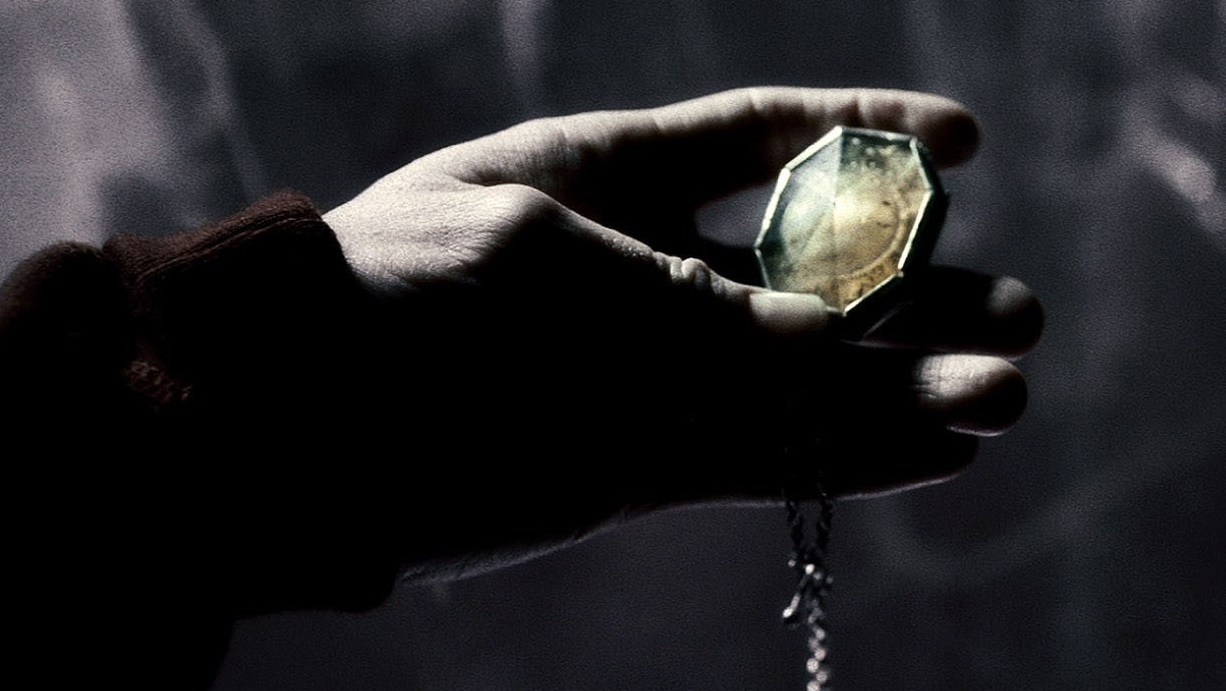
Salazar Slytherin's Locket
The allure of immortality is a deeply intriguing one, tempting even the most virtuous of individuals with promises of eternal life and power beyond measure. Yet, the creation of a Horcrux exacts a terrible price - not only in the loss of an individual's humanity and empathy but also in the irreversible corruption of the soul itself.
"A Horcrux is the word used for an object in which a person has concealed part of their soul... Well, you split your soul, you see, and hide part of it in an object outside the body. Then, even if one's body is attacked or destroyed, one cannot die, for part of the soul remains earthbound and undamaged."
— Horace Slughorn on the nature of Horcruxes
The deed in question requires the perpetrator to commit murder, an unspeakable act that tears the soul apart and allows them to encase a piece of it within the chosen object. It is for this reason that it states clearly that only a dark witch or wizard would be able to accomplish such a task, ruthlessly murdering without question for their own gain. Upon completing this act, evil of all evils, they must invoke a spell and commit further horrifying acts. Whilst there could be more than one Horcrux, there seemed to be a limit, possibly resting at 7, at which point the weakened being could not handle a further splintered soul.
Creating multiple Horcruxes, a greater attempt at preservation, is suggested to be costly to the creator, by both diminishing their humanity and even physically disfiguring them to the point of becoming a humanoid abomination of their former selves, deformations which only worsened had they further meddling into other Dark Arts at the same time.
The notion of defeating a Horcrux is a subject steeped in danger, yet it's not an impossible task. Horcruxes can be destroyed only in some specific ways, otherwise, they will regenerate. This means it must be destroyed beyond physical or magical repair. The first crucial step in dismantling this dark magic lies in identifying the Horcrux itself. These malevolent creations can take various forms, from objects that seem ordinary in daily life to ancient artefacts, requiring thorough research and perhaps even divined support to unearth their hiding places.
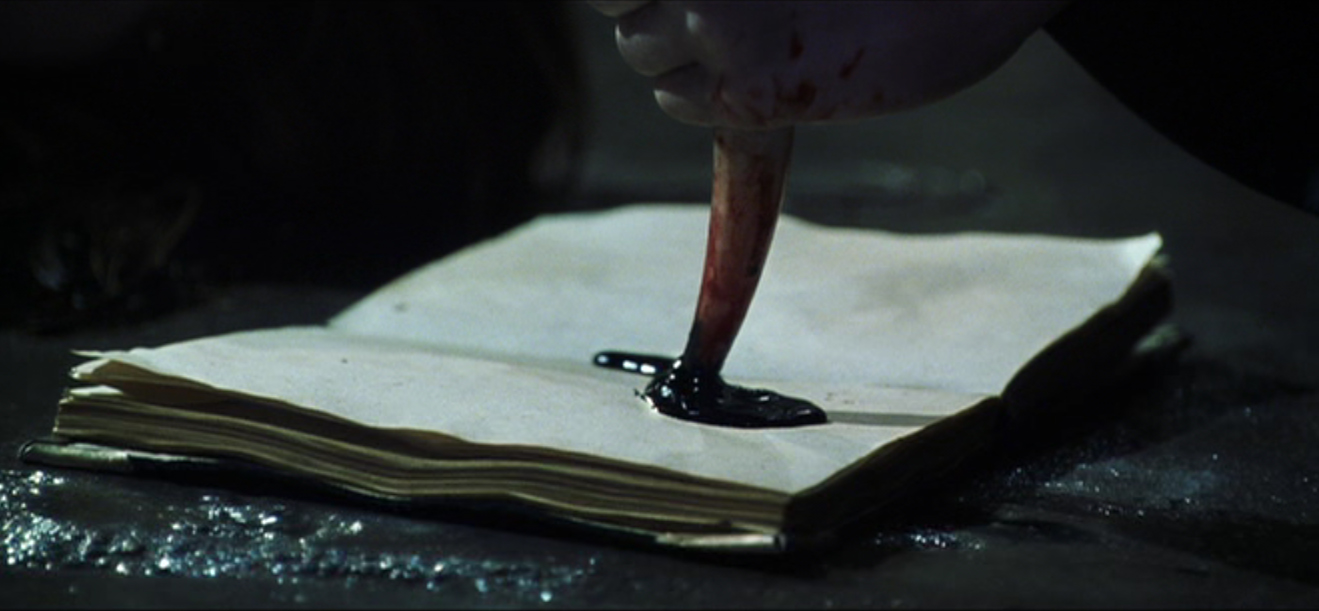
Tom Riddle's Diary
Once the Horcrux is identified, the next challenge is to destroy its physical form. Traditional magical often proved ineffective against these creations of evil, coated in dark magic as they are, necessitating extreme measures. As precious artefacts, they were naturally guarded with various spells and as many protective measures as possible by their creators in an attempt at preservation. Powerful spells such as the Killing Curse can inflict significant damage, but the dark magic coursing through the magical signature of namely the Fiendfyre of Basilisk Venom can outdo the magic of the Horcrux and destroy it. The Sword of Gryffindor was also successful in this regard, for taking on the properties of the Basilisk venom and absorbing them.
Nevertheless, the greatest challenge lies not in the physical destruction, but in the resilience required to confront the dark magic associated with the Horcrux's creation. Turning individuals who face prolonged contact with the artefacts into evil creatures themselves.
"You were the seventh Horcrux, Harry, the Horcrux he never meant to make. He had rendered his soul so unstable that it broke apart when he committed those acts of unspeakable evil, the murder of your parents, the attempted killing of a child. But what escaped from that room was even less than he knew. He left more than his body behind."
— — Albus Dumbledore informing Harry Potter about the state of Voldemort's soul
Herpo the Foul, renowned for his mastery of the darkest of magics, has left a legacy that has echoed through the ages of the wizarding world.
Herpo's fame stems not only from his being the first to create the mighty Basilisk but primarily from his creation of one of the most sinister magical artefacts known to wizardkind – the Horcrux. Legends tell of Herpo's twisted experiments in soul-splitting magic, his insane attempts to anchor his own soul to the mortal realm, granting him a twisted form of immortality.
It is said that Herpo's obsession with immortality drove him to commit unspeakable acts of cruelty and darkness, as he sought to defy the natural order and cheat death itself. Although it is unknown what his Horcrux was, we know it was successful in tethering him to the mortal world and granting him power beyond comprehension for a time long enough to earn him the epithet 'the Foul'.
Despite this, he serves solely as a grim reminder of the corruption of power and darkness and how searching too deep can only come upon a hefty price. His legacy remains longer than his soul, to remind us of the danger lurking within experimenting with darkness.
Tom Riddle's Diary was a special magical diary that preserved the teenage version of Voldemort, aka Tom Riddle. His memory and personality was stored away in this book. Upon first glance, it was just an empty old journal. But that was far from the truth. This was Voldemort's very first horcrux intentionally created. This one was particularly dangerous because it could actively possess and influence people who interacted with it. A great example of it's danger was how it was used to manipulate Ginny Weasley into opening the Chamber of Secrets. This was destroyed early on before it was even known to be a Horcrux by Harry Potter himself. He used a Basilisk fang and the venom destroyed the soul fragment inside.
This ring was another one of Voldemort's horcruxes. It belonged to Voldemort's maternal grandfather, descended from Salazar Slytherin. This ring contained the Ressurection Stone inside, which is one of the three Deathly Hallows. This ring connected him to both the Gaunt family and Slytherin bloodline. It was important to Voldemort because it symbolized his obsession with pure-blood heritage. It carried a deadly cursed that affected Albus Dumbledore. It left physical evidence of his hand, turning it a sickly grey color and began to spread. Albus Dumbledore destroyed it with the Sword of Gryffindor.
Salazar Slytherin's Locket was one of the seven horcruxes, and even once was owned by Salazar Slytherin himself. As you can imagine, Voldemort was drawn to this and it represented his pride in being Slytherin's heir. He treasured this artifact above most others. This locket was also dangerous because it psychologically attacked whoever wore it. The wearer's fear and insecurity would also be amplified while wearing it. It was later destroyed by Ron Weasley using the Sword of Gryffindor. This was a signficant moment for him because it represented him overcoming his deepest insecurities.
This horcrux was a golden cup belonging to Helga Hufflepuff. It was passed down to Hepzibah Smith. Voldemort poisoned her and then transformed the cup into a horcrux. Her house elf, Hokey, was blamed for her death and imprisoned. Voldemort had an obsession with historical relics, which is one of the reasons he chose this cup as one of the horcruxes. It was later hidden in Bellatrix Lestranges vault making it nearly impossible to suspect or find. It was eventually found and destroyed by Hermione Granger with a Basilisk fang during the Battle of Hogwarts. This action was a significant moment in her relationship with Ron Weasley, where they shared a passionate kiss, silently expressing their unwavering love for one another.
This horcrux was a beautifully crown decorated with royal blue jewels that belonged to Rowena Ravenclaw. Legend says that it was said to enhance wisdom on one who wore it. It was hidden well inside of the Room of Requirement at Hogwarts. Voldemort believed it was one of the safest places to hide such powerful magic as one wouldn't typically think to hunt a school full of children for such a dark artifact. This horcrux was accidentally destroyed by Vincent Crabbe, who cast Fiendyre. Due to him not being that talented at magic, the spell went awry and sent the entire Room of Requirement up in flames. During a split second decision, Ron kicked the diadem into the Room of Requirement where it was destroyed and engulfed by the large flames.
Nagina was one of the smartest horcruxes created because the snake companion stayed at his side most of the time. She was a giant, powerful snake who's attack and bite could easily end a life. She was the only living creature Voldemort intentionally turned into a horcrux. Her significance demonsrated how dangerous and inhuman Voldemort was. She could not be killed with basic magic. This horcrux was destroyed by Neville Longbottom. He killed Nagini using the Sword of Gryffindor during the Battle of Hogwarts.
Harry Potter was the only unintentional Horcrux created. Voldemort killed Lily and James Potter and then tried to kill Harry Potter, who was the only person to ever survive the Killing Curse due to being protected by his Mother's unconditional love. During his attempt, a fragment of his damaged soul accidentally attached itself to Harry. This created a mental and magical connection between Harry and Voldemort, which was intensified as the years went on and explained the reason why Harry was a Parseltongue. Harry figured out he was a Horcrux after his long and gruesome hunt for them and sacrified himself for the greater good of the wizarding world. Ironically, Voldemort destroyed the last and final Horcrux himself when he attempted to kill him a second time.
For Lord Voldemort, the pursuit of immortality through Horcruxes became an obsession that consumed him utterly. By splitting his soul into six fragments - his diary, his father’s (Marvolo Gaunt) family ring, Salazar Slytherin’s Locket, Helga Hufflepuff’s Cup, Rowena Ravenclaw’s Diadem, Nagini - and an accidental seventh - Harry Potter - he believed himself to be invincible, beyond the reach of death's cold embrace. In the end, he remained stuck in an eternal limbo, unable to progress from his past. Never quite truly meeting death but not sustaining life.
"Voldemort's fear is death, ignominious death. I mean, he regards death itself as ignominious. He thinks that it's a shameful human weakness, as you know.”
— J.K Rowling about Voldemort's thantophobia.
The tale of Horcruxes serves as a cautionary reminder of the dangers of hubris and the consequences of tampering with dark magic. The pursuit of immortality, though tempting, ultimately leads only to decay and moral degradation, leaving behind a trail of ruin and despair.
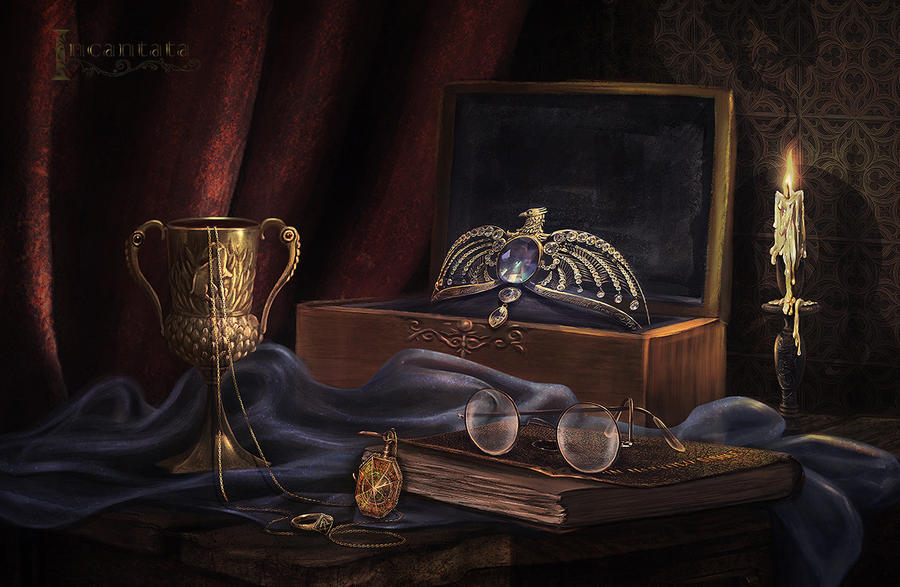
The Seven Horcruxes (by incantata)
If you had a Horcrux, what would it be?